




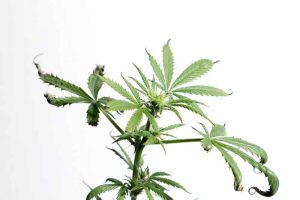
Cannabis leaves curling is one of the earliest warning signs that something isn't quite right with your plant. Whether you notice cannabis leaves curling up, cannabis leaves curling down, or cannabis leaves curling downward, the direction and appearance of the leaves can provide valuable clues about the underlying problem. In most cases, leaf curling is caused by environmental stress, watering mistakes, nutrient imbalances, root problems, or pests rather than disease. Identifying the symptoms early allows growers to correct the issue before it affects healthy growth, flowering, or yields. This guide explains how experienced growers diagnose leaf curling by observing the leaves, growing medium, and environment before making any adjustments. You'll learn how to identify the most common causes of cannabis leaves curling, understand why they happen, and follow practical, beginner-friendly solutions to restore healthy growth. You'll also discover how to prevent future problems and recognize when leaf tips curling up and turning brown require immediate attention.
Key Takeaways
- Identify the type of leaf curl before taking action. Cannabis leaves curling up, cannabis leaves curling down, and clawed leaves can all indicate different problems, so always diagnose the symptoms before making changes.
- Check your growing environment first. Heat, light intensity, humidity, watering practices, and airflow are the most common causes of cannabis leaves curling and should be ruled out before adjusting nutrients.
- Healthy new growth is the best sign of recovery. Existing curled leaves may not return to normal, but flat, vibrant new leaves indicate that the underlying problem has been corrected.
- Most cases of leaf curling can be prevented. Maintaining stable temperatures, watering only when needed, using well-draining growing media, and inspecting plants regularly will significantly reduce the risk of leaf curling.
- Make one adjustment at a time. Changing your watering schedule, nutrients, lighting, and environment all at once makes it difficult to identify the real cause. Experienced growers correct one issue, monitor the plant for 24–72 hours, and then reassess if necessary.
What are curling cannabis leaves?
Cannabis leaves curling is one of the earliest visible signs that a plant is experiencing stress. Healthy leaves should appear flat, open, and slightly angled toward the light. When the leaves begin curling upward, downward, or inward, it usually indicates that the plant is responding to changes in its environment or growing conditions. While curled leaves can look concerning, they are a symptom rather than a disease, making early diagnosis essential for maintaining healthy growth.
The direction of the curl can provide useful clues about the underlying issue. Cannabis leaves curling up are often linked to environmental factors such as excessive heat, intense light, or low humidity. In contrast, cannabis leaves curling down, sometimes described as cannabis leaves curling downward, is more commonly associated with watering problems, nutrient imbalances, or root stress. In some cases, weed plant leaves curling down may occur alongside other symptoms, such as drooping foliage or unusually dark green leaves, which can help identify the cause more accurately.
Quick Guide on Cannabis Leave Curling
| Leaf Curl Pattern | Description | Common Causes |
| Curling Up | Leaves bend upward at the edges or tips, sometimes forming a “taco” shape | Heat stress, excessive light, low humidity |
| Curling Down | Leaves droop or curl downward, often appearing heavy or limp | Overwatering, root stress, poor drainage |
| Curling Downward (Clawing) | Leaves curl sharply downward at the tips, resembling a claw | Nitrogen toxicity, nutrient imbalance |
| Canoeing or Tacoing | Leaf edges fold upward while the center remains flat | High temperatures, intense light exposure |
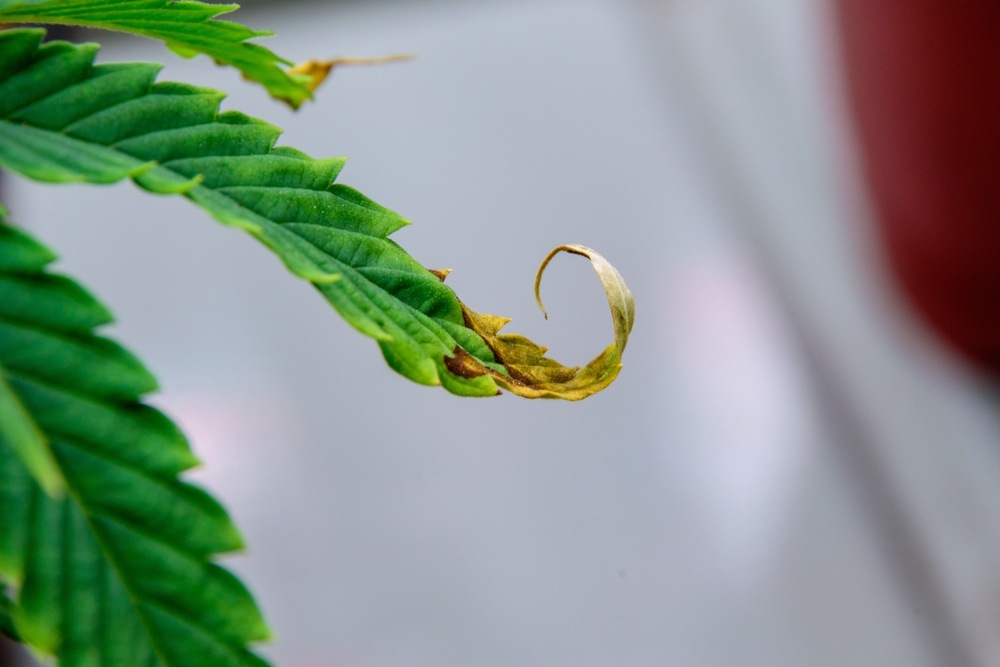
| Leaf Tips Curling Up and Turning Brown | Tips curl and show discolouration or burn | Nutrient burn, salt buildup, overfeeding |
| Twisting or Irregular Curling | Leaves twist or curl unevenly in multiple directions | pH imbalance, pests, environmental stress |
Because several problems can produce similar symptoms, growers should avoid making assumptions based on leaf curling alone. If your plants are showing multiple issues at the same time, our guide to common cannabis leaf symptoms can help you identify the underlying problem. Instead, inspect your growing environment, watering routine, nutrient program, and root health together. Taking a systematic approach allows you to identify the source of the stress and restore healthy plant development before yields are affected.
How to identify why your cannabis leaves are curling up
If your cannabis leaves are curling up, avoid changing your nutrients or watering routine until you have identified the likely cause. Many beginner growers mistake environmental stress for a feeding problem, and adding more fertiliser or water can make the symptoms worse. The best approach is to inspect the plant in a set order and rule out the most common causes one by one.
Quick diagnosis guide
| If your leaves look like this... | Most likely cause | What to do |
| Upper leaves curling into a “taco” or “canoe” shape | Heat or light stress | Raise or dim the grow lights, improve ventilation, and reduce canopy temperatures. |
| Dry, crispy leaves with curled edges | Low humidity or dry conditions | Increase humidity and stop fans from blowing directly onto the leaves. |
| Soft curled leaves with wet soil | Overwatering or root problems | Allow the growing medium to dry and improve drainage. |
| Leaf tips curling up and turning brown | Nutrient burn | Flush excess salts and reduce nutrient strength. |
| Curling limited to leaves near a fan | Wind burn | Reposition the fan to provide gentle, indirect airflow. |
Step-by-step diagnosis guide
Step 1: Check where the curling starts
Look at the whole plant rather than one damaged leaf. If the curling is mainly on the upper canopy closest to the grow lights or direct sunlight, excessive heat or light is the most likely cause. If symptoms appear throughout the entire plant, investigate the watering routine, drainage, and root zone.
Step 2: Feel the affected leaves
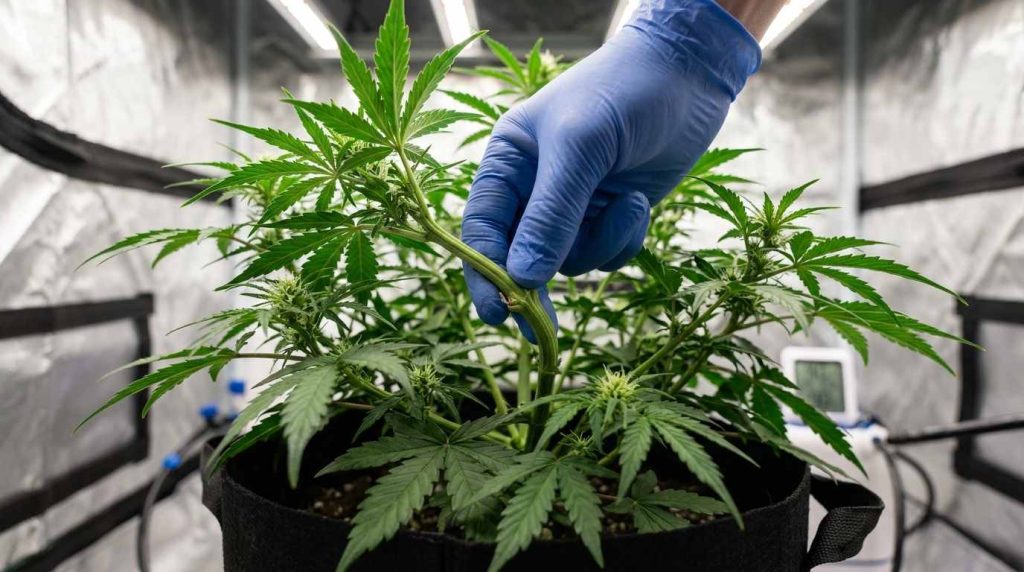
Dry, brittle, or crispy leaves usually point to heat, low humidity, or strong airflow. Soft leaves that curl upward are more likely to be associated with wet soil, poor drainage, or stressed roots.
This distinction is important because dry leaves usually indicate excessive moisture loss, while soft leaves often mean the roots are unable to function correctly.
Step 3: Check the growing medium
Push a finger about an inch into the soil or lift the pot to judge its weight. If the medium remains wet for several days, the roots may not be receiving enough oxygen. Allow the soil to dry slightly before watering again, and make sure excess water can drain freely from the container.
Avoid watering on a fixed schedule. Cannabis plants should be watered according to the condition of the growing medium rather than the day of the week.
Step 4: Inspect the leaf tips and colour
Leaf tips curling up and turning brown are often an early sign of nutrient burn. If the problem continues, the leaves may also begin cannabis leaves turning yellow, indicating the stress is becoming more severe. The leaves may also appear unusually dark green. If this matches your plant, flush the growing medium with pH-balanced water and restart feeding at a lower strength once healthy new growth appears.
Step 5: Review the environment
Check the temperature, humidity, grow-light distance, and fan position. High temperatures combined with low humidity commonly cause more severe upward curling than either issue alone. If you're unsure how to maintain stable humidity throughout each stage of growth, our guide to grow room humidity control explains how to create the ideal environment. Fans should move the leaves gently rather than blowing continuously at one part of the plant.
What to do after making an adjustment
Make one change at a time and monitor the plant for 24–72 hours. Take clear photos before and after each adjustment so you can compare the symptoms. Healthy new growth should begin to appear within several days once the underlying issue has been corrected. Existing curled leaves may not flatten completely, but they should stop becoming worse.
Grower's Tip: Resist the temptation to fix everything at once. If you adjust your lights, watering, nutrients, and humidity on the same day, it becomes almost impossible to identify what caused the problem. Make one change, monitor your plants for 24–72 hours, and only make further adjustments if the symptoms continue.
How to identify why your cannabis leaves are curling down
If your cannabis leaves are curling down, don't rush to water or feed your plants. Downward curling is one of the easiest symptoms to misdiagnose because several different problems can produce similar-looking leaves. The key is to identify how the leaves are curling before deciding what to do next.
Experienced growers begin by asking four simple questions:
- Are the leaves soft and drooping, or firm and clawed?
- Is the growing medium wet or dry?
- Are the leaves a healthy green or unusually dark?
- Are there any signs of insects or environmental stress?
Answering these questions will help you identify the cause much more accurately than treating the symptom alone.
Quick diagnosis guide
| If your leaves look like this... | Most likely cause | What to do |
| Entire leaves hang down and feel soft while the soil remains wet | Overwatering or root problems | Allow the growing medium to dry, improve drainage, and avoid watering until the top layer is dry. |
| Leaf tips hook downward into a claw while the leaves remain firm and dark green | Nitrogen toxicity | Flush the growing medium with pH-balanced water and reduce nitrogen in future feedings. |
| Leaves appear heavy or slightly droopy during periods of high humidity | Excessive humidity | Reduce humidity with a dehumidifier, improve ventilation, and increase air circulation. |
| Leaves droop during very hot conditions and recover as temperatures fall | Heat stress | Lower grow room temperatures, improve ventilation, and reduce heat around the canopy. |
| Downward curling with yellow spots, webbing, or insects | Pests | Inspect both sides of the leaves and treat the infestation before it spreads. |
Step-by-step diagnosis guide
Step 1: Check whether the leaves are drooping or clawing
This is the easiest way to narrow down the problem.
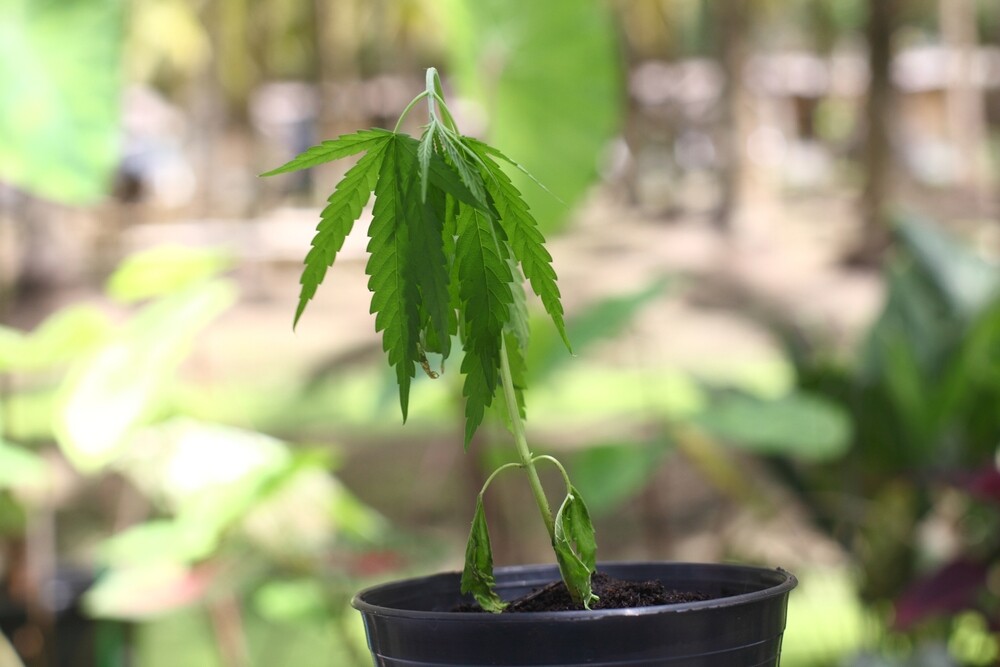
Drooping leaves usually bend downward from the stem and feel soft or limp. If you're unsure whether your plant is drooping or curling, our guide to drooping cannabis leaves explains the differences in more detail. The entire leaf hangs toward the ground because the roots are struggling to supply the plant with water and oxygen. This is most commonly caused by overwatering, root problems, or excessive humidity.
Clawed leaves look very different. The leaf itself remains firm, but only the tip curls sharply downward, creating a hook or claw shape. The foliage is often dark green and may appear thick or waxy. This is a classic sign of excess nitrogen rather than a watering problem.
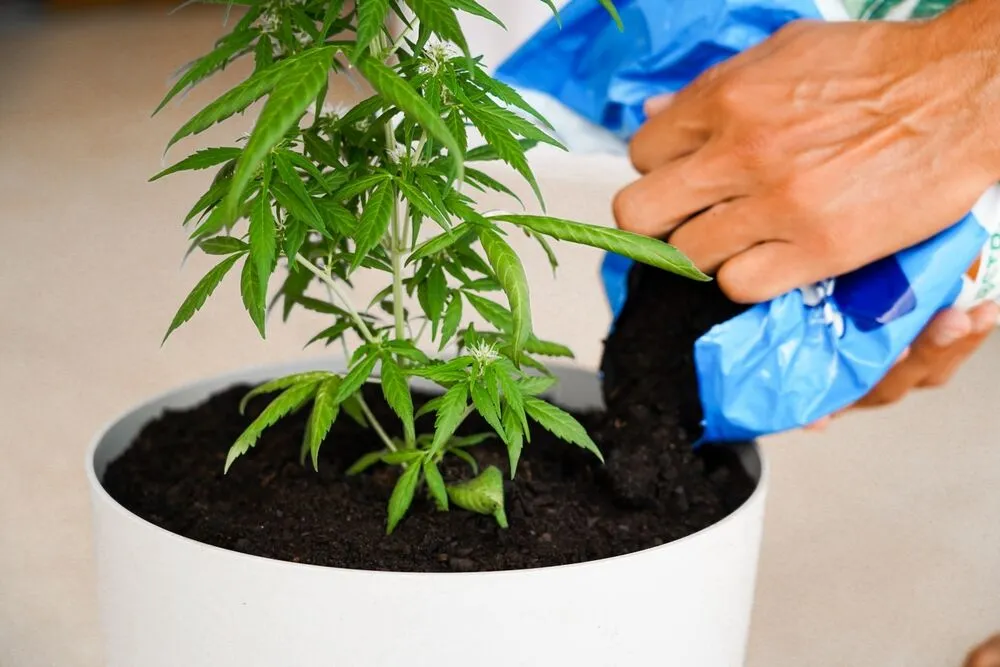
Step 2: Check the growing medium
Push your finger about an inch into the soil or lift the pot to judge its weight.
If the growing medium remains wet several days after watering, overwatering is the most likely cause of weed plant leaves curling down. Healthy roots require oxygen as well as water, and constantly saturated soil can eventually lead to root rot. Learning how to water your cannabis plants correctly is one of the best ways to prevent overwatering in the future. Allow the medium to dry before watering again and make sure your containers have adequate drainage.
Step 3: Review the growing environment
Environmental conditions can also cause cannabis leaves curling downward.
If humidity remains too high, the plant struggles to release moisture through transpiration, causing the leaves to appear heavy or slightly droopy. Likewise, prolonged temperatures above 85°F (29°C) can overwhelm the plant, leading to temporary drooping as it loses water faster than it can replace it.
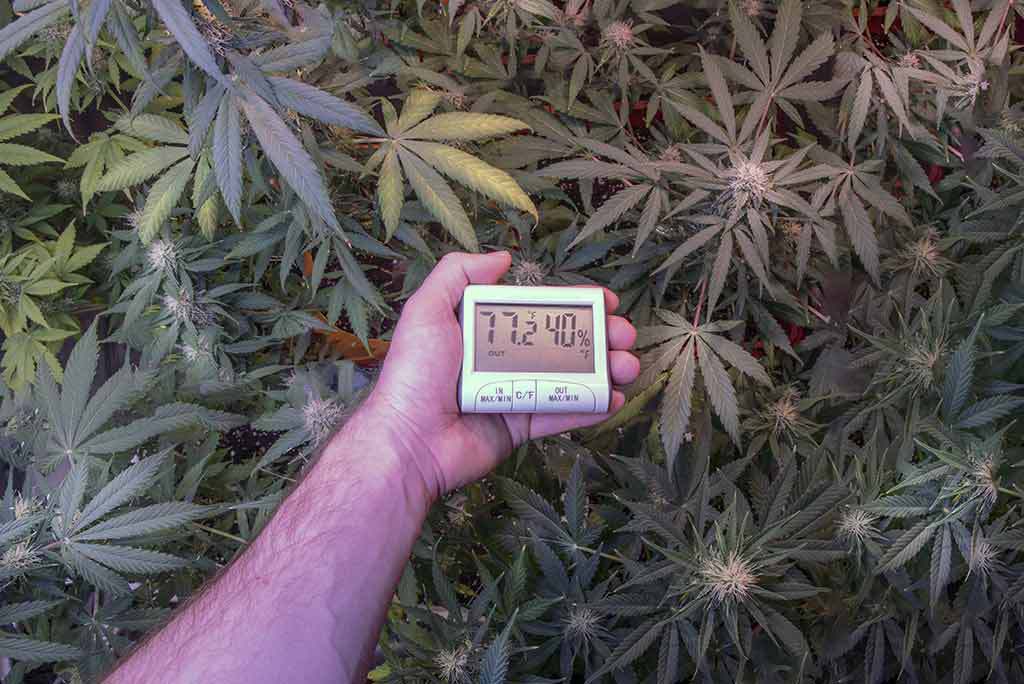
Aim to maintain temperatures between 70–75°F (20–24°C) with humidity around 60–70% during vegetative growth and 40–50% during flowering.
Step 4: Inspect for pests
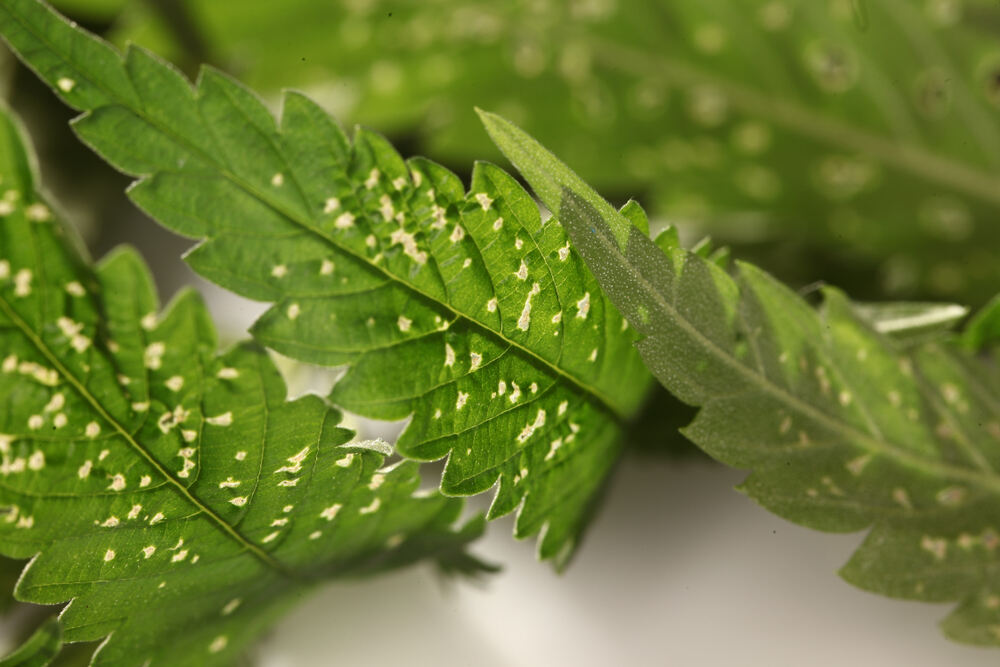
Finally, turn over several leaves and inspect the undersides carefully. Spider mites, aphids, and thrips feed on plant sap, weakening the leaves and causing them to curl downward over time. If damaged leaves also begin developing brown spots on cannabis leaves, the problem may be related to nutrient deficiencies, disease, or pest damage. Catching pests early makes them much easier to eliminate using insecticidal soap, neem oil, or beneficial insects.
What to do after making an adjustment
Once you've identified the most likely cause, make one correction at a time and observe your plants over the next 24–72 hours. Avoid changing your watering schedule, nutrients, lighting, and environment all at once, as this makes it difficult to determine which adjustment solved the problem. Healthy new growth should begin to appear within several days once the underlying issue has been corrected, although existing curled leaves may not fully recover.
Grower's Tip: If you're unsure whether you're dealing with overwatering or nitrogen toxicity, don't look at the leaf first—look at the soil. Wet soil combined with soft, drooping leaves almost always points to watering or root problems, while firm, dark green leaves with hooked tips are far more likely to indicate excess nitrogen. Using the soil and the leaf together is one of the quickest ways experienced growers diagnose downward curling.
Can curled cannabis leaves recover?
Yes, curled cannabis leaves can recover, but it depends on what caused the problem and how quickly it's corrected. In most cases, leaf curling is a stress response rather than permanent damage. If you identify the cause early and restore the correct growing conditions, your cannabis plant can continue to grow normally with little or no impact on its overall health.
One of the biggest misconceptions among beginner growers is expecting damaged leaves to return to their original shape. In reality, severely curled or damaged leaves rarely flatten completely, even after the underlying issue has been fixed. Instead of focusing on older leaves, experienced growers monitor new growth, as this is the most reliable indicator that the plant is recovering.
The speed of recovery depends on the severity of the stress. Minor problems, such as slightly low humidity or mild cannabis heat stress, often begin improving within 2–5 days after the environment has been corrected. More serious issues, including overwatering, nutrient toxicity, root damage, or pest infestations, can take one to three weeks before healthy new growth becomes consistent.
If excessive heat continues into late flowering, it can also contribute to foxtailing buds, reducing the quality and appearance of your harvest.
Recovery timeline by cause
| Problem | Typical Recovery Time | What to Expect |
| Heat stress | 2–5 days | Leaves stop curling and new growth appears normal once temperatures are stable. |
| Low humidity | 1–3 days | Leaves regain firmness and stop curling as humidity improves. |
| Overwatering | 3–7 days | Drooping improves as the soil dries and roots regain oxygen. |
| Nutrient toxicity | 5–10 days | New growth appears healthier after flushing and adjusting feeding. |
| Root damage | 1–3 weeks | Slower recovery as roots repair and new growth gradually improves. |
| Pest infestations | Varies | Recovery depends on how quickly pests are controlled and damage is limited. |
If the curling continues to spread after you've corrected the suspected cause, stop making additional changes and reassess the plant. Check your temperature, humidity, watering routine, nutrient schedule, and the undersides of the leaves for pests. In many cases, cannabis leaves curling is caused by more than one stress occurring at the same time, so addressing only one issue may not completely solve the problem.
Signs your cannabis plant is recovering
- New leaves grow flat and healthy without curling.
- Leaf colour returns to a normal, vibrant green.
- Growth becomes faster and more vigorous.
- Curling stops spreading to new leaves.
- The plant begins producing strong, healthy shoots.
When should you worry?
If new growth continues to curl after 7–10 days, or you notice rapid yellowing, dying leaves, a foul smell from the growing medium, or a severe pest infestation, the underlying problem may still be present. Recheck your diagnosis before making further adjustments, as repeatedly changing your watering, nutrients, lighting, and environment can place even more stress on the plant.
Grower's Tip: Don't judge recovery by the oldest leaves. Experienced growers always watch the newest growth because it's the first place you'll see improvement. Even if older leaves stay curled, healthy new growth is a strong sign that your cannabis plant is back on track.
How to prevent cannabis leaves from curling
Preventing cannabis leaves from curling is easier than correcting the problem after damage appears. Most cases develop gradually because of unstable temperatures, poor watering habits, excessive nutrients, unsuitable containers, or unnoticed pests. Beginner growers can reduce the risk by following the same basic checks each time they inspect their plants. If you're just starting out, choosing beginner cannabis seeds can also make cultivation easier, as resilient genetics are generally more forgiving of minor environmental mistakes.
Cannabis leaf-curl prevention guide
| What to check | What the grower should do | What it helps prevent |
| Temperature | Keep daytime temperatures around 70–75°F (20–24°C) and remove excess heat with ventilation or extraction. | Heat stress, tacoing, canoeing, and dry upward-curling leaves |
| Humidity | Maintain approximately 60–70% relative humidity during vegetative growth and 40–50% during flowering. | Dry, brittle leaves, excessive moisture, drooping, and fungal problems |
| Grow lights | Follow the manufacturer’s hanging-height recommendations and watch the upper canopy for bleaching or taco-shaped leaves. | Light stress and cannabis leaves curling up |
| Watering | Water according to the condition of the growing medium rather than a fixed schedule. | Overwatering, oxygen-starved roots, drooping, and root rot |
| Nutrients | Start with the recommended dose and increase nutrient strength gradually. | Nutrient burn, nitrogen toxicity, clawing, and brown curled tips |
| Airflow | Use gentle, indirect airflow that causes light leaf movement without continuously hitting one area. | Wind burn, dry leaf edges, and localized curling |
| Pests | Check the tops and undersides of leaves several times each week. | Curling caused by mites, aphids, thrips, and other sap-feeding pests |
| Containers and medium | Use containers with drainage holes and a loose, well-aerated growing medium. | Waterlogging, compacted roots, poor oxygen levels, and downward curling |
Step 1: Stabilize the growing environment
Begin by placing a digital thermometer and hygrometer close to the canopy. This gives you a more accurate reading of the conditions affecting the leaves than a monitor positioned on the floor or outside the grow space. These environmental checks are especially important when growing indoor cannabis seeds, where temperature, humidity, and light intensity are completely controlled by the grower.
Keep temperature and humidity changes gradual. Sudden swings can stress the plant even when the final readings fall within the correct range. While indoor growers can adjust their environment more easily, growers raising outdoor cannabis seeds may need to provide temporary shade, improve airflow, or protect plants during periods of extreme weather.
Step 2: Check the grow-light position
Inspect the leaves at the top of the plant. If they begin curling upward into a taco or canoe shape, appear pale, or feel dry, the lights may be too close or too intense.
Raise or dim the fixture according to the manufacturer’s guidance. Avoid guessing the ideal distance, as different LED and high-intensity fixtures produce very different amounts of light and heat.
Step 3: Use suitable containers and growing media
Choosing the best types of pots for growing cannabis plants is one of the easiest ways to prevent waterlogging and root stress. Fabric pots and air-pruning containers improve oxygen movement around the roots, while standard plastic pots should have several unobstructed drainage holes.
The growing medium should remain loose rather than compacted. Soil growers can add an aeration material such as perlite to improve drainage and reduce waterlogging. Avoid pressing the medium tightly around the roots, as compacted soil holds excess moisture and limits oxygen.
Place pots on trays or raised stands so drainage water does not collect around the bottom of the container.
Step 4: Water according to the plant’s needs
Before watering, check the top inch of the growing medium and lift the pot. A lighter pot and a dry upper layer usually indicate that watering is needed. If the pot still feels heavy or the medium remains damp, wait and check again later.
Water thoroughly enough to moisten the root zone, then allow excess water to drain. Do not leave the container standing in runoff. This routine helps prevent the soft, drooping leaves commonly associated with overwatering and root stress.
Step 5: Feed carefully
Begin with the nutrient manufacturer’s recommended dose, or a lower dose for young or sensitive plants. Avoid increasing nutrients simply because growth appears slow.
Watch for dark green, glossy leaves, downward clawing, or leaf tips curling up and turning brown. These are early warnings that the plant may be receiving more nutrients than it can use. Reducing the feed early is easier than correcting advanced nutrient toxicity.
Step 6: Set up gentle airflow
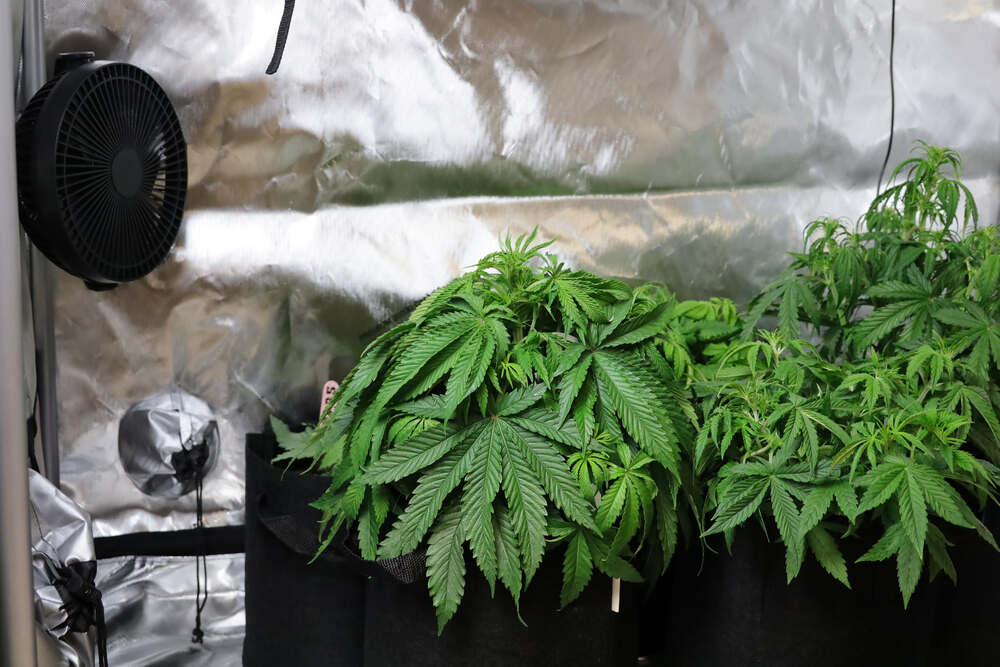
Position oscillating fans so air moves around the canopy rather than blowing continuously at one plant. The leaves should move gently, not flap or bend sharply.
Strong direct airflow can remove moisture from the leaf surface too quickly, resulting in dry edges, a leathery texture, and upward curling.
Step 7: Inspect the plants regularly
Spend a few minutes checking your plants each day. Look at new growth, leaf colour, soil moisture, and the underside of several leaves. Use a magnifying glass to check for small pests, eggs, webbing, or yellow speckling. Regular inspections also make it much easier to identify cannabis pests and diseases before they become serious problems.
Record temperature, humidity, watering, and feeding changes in a simple grow diary. If curling develops, these notes can help you identify what changed before the symptoms appeared.
Step 8: Correct one issue at a time
When you notice early curling, avoid changing the lights, nutrients, watering routine, and humidity all at once. Make the most likely correction, take a photo, and monitor the newest growth for 24–72 hours.
Grower’s Tip: Prevention starts at the roots. A well-draining container, loose growing medium, and sensible watering routine prevent many of the problems that cause cannabis leaves curling down. Once the root zone is healthy, it becomes much easier to manage lighting, nutrients, humidity, and airflow without placing the plant under unnecessary stress.
Frequently Asked Questions
Can curled cannabis leaves recover?
Yes. In most cases, cannabis plants recover well once the underlying cause has been corrected. However, severely curled or damaged leaves usually won't return to their original shape. Instead, look for healthy new growth, as this is the best indication that your plant is recovering.
Should I remove curled cannabis leaves?
Not usually. Curled leaves can still photosynthesize and provide energy for the plant. Only remove leaves that are completely dead, badly damaged, or affected by disease or pests. Healthy new growth is a better indicator of recovery than the appearance of older leaves.
Why are my cannabis leaves curling up?
Cannabis leaves curling up is most commonly caused by heat stress, excessive light, low humidity, root problems, nutrient burn, or strong airflow. Check where the curling starts, whether the leaves feel dry or soft, and review your growing conditions before making any adjustments.
Why are my cannabis leaves curling down?
Cannabis leaves curling down is usually caused by overwatering, excessive nitrogen, high humidity, root problems, or pest damage. Soft, drooping leaves often indicate watering issues, while firm leaves with hooked tips (known as clawing) are more commonly associated with nitrogen toxicity.
What causes leaf tips curling up and turning brown?
Leaf tips curling up and turning brown are usually an early sign of nutrient burn caused by overfeeding or excess salt buildup in the growing medium. Flushing the growing medium with pH-balanced water and reducing nutrient strength can often prevent the problem from becoming more severe.
Can LED grow lights cause cannabis leaves to curl?
Yes. If LED grow lights are too close to the canopy or set to a high intensity, they can cause light stress. The upper leaves often curl upward into a taco or canoe shape as the plant tries to reduce its exposure to excessive light and heat. Raising or dimming the lights usually resolves the problem.
Can overwatering cause cannabis leaves to curl?
Yes. Overwatering reduces the amount of oxygen available to the roots, making it difficult for the plant to absorb water and nutrients efficiently. This often results in soft, drooping leaves that curl downward and, if left untreated, can eventually lead to root rot.
How long does it take for cannabis leaves to recover?
Recovery depends on the cause of the problem. Mild environmental stress may improve within 2–5 days, while overwatering, nutrient toxicity, root damage, or pest infestations can take one to three weeks before healthy new growth appears. Existing curled leaves may not fully recover, so monitor the newest growth instead.
How can I prevent cannabis leaves from curling?
The best way to prevent cannabis leaves curling is to maintain stable temperatures and humidity, water only when the growing medium needs it, avoid overfeeding, provide good drainage and airflow, and inspect your plants regularly for pests or signs of stress. Catching problems early is much easier than correcting them once leaf curling develops.


